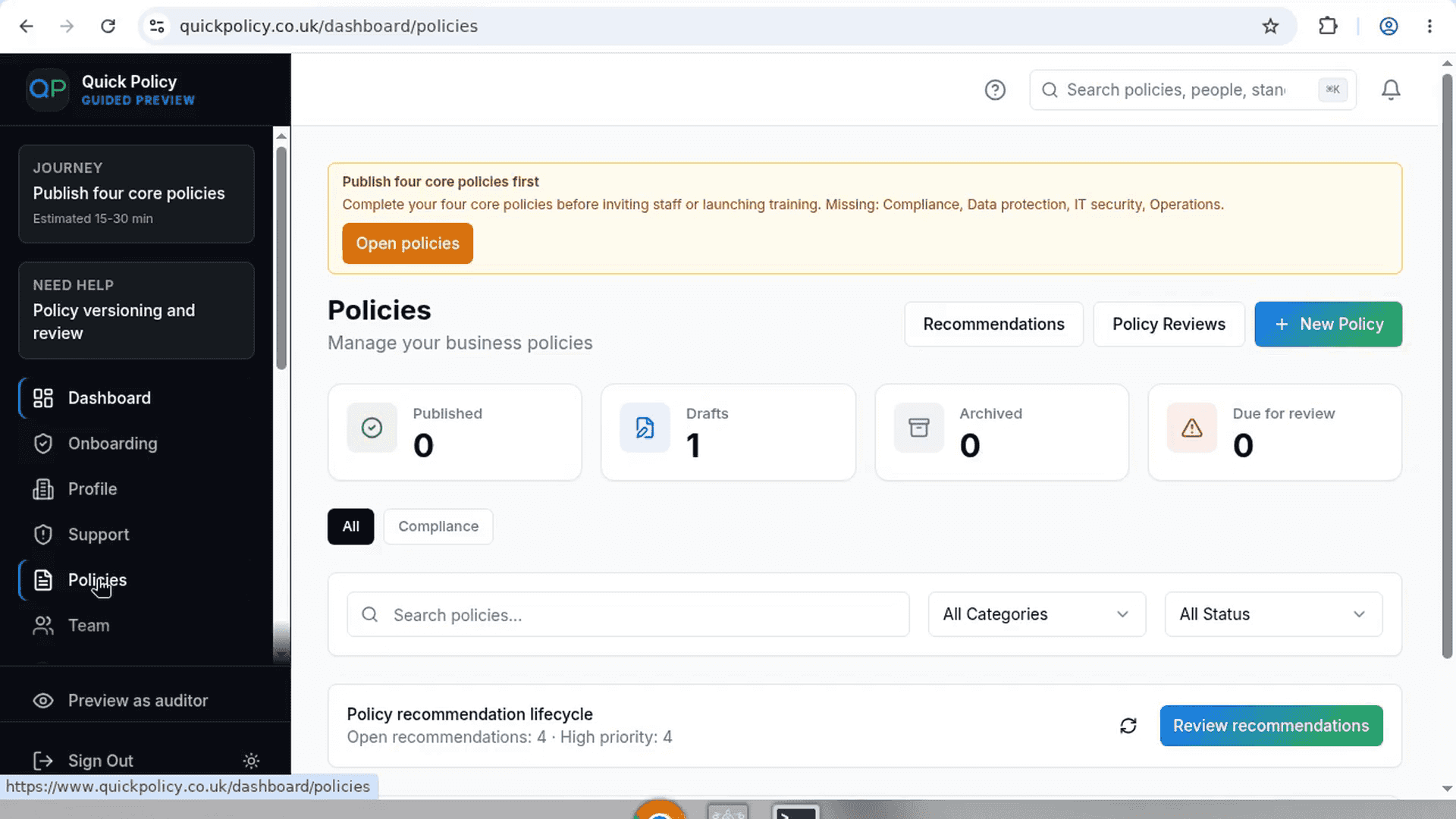
The platform
From your organisation profile to policies your staff have signed
Policies written from how your organisation works, scored against ISO 27001, SOC 2 and UK GDPR with every gap listed, approved, published, signed off by staff and backed by training and audit evidence.
How it starts
Capture your organisation profile, generate four core drafts, review them against the standards you chose, and publish one — all before you pay.
Guided preview and onboarding
No card required. Core onboarding captures sector, size, and jurisdiction so the first drafts are grounded in your organisation, not a generic template pack.
Outcome: A verified organisation profile that unlocks generation of the four core policy drafts.
Four core policy drafts
AI drafts the first four policies from that profile. Other policy families can be generated once you are set up; the preview is not a 15-template library.
Outcome: Review-ready drafts you can edit before anything is published.
ISO 27001, SOC 2, and UK GDPR review
Score the drafts against the frameworks you selected. A PASS scorecard on ISO 27001 and SOC 2 is the starting review, not a finished audit programme.
Outcome: See gaps in plain English, publish one policy in the preview, and choose a plan for the rest.
After the policies: running them
Which plans include each module is read from the same entitlements as the pricing table. Team invitations and training open once your four core policies are published, so staff are never asked to sign a half-finished set.
Sign-off and training
A policy nobody has acknowledged is a document, not a control. Published policies go to staff to read and sign, and training with quizzes is generated from the policy text itself, so what people are tested on is what you actually wrote.
Included in Foundation and Professional
Incidents and risk
A risk register you can actually keep current, and — on Professional — incident management that records what happened, who did what and when, who was told, and which policies it touched.
Included in Professional
Health and safety assessments
Risk assessments, COSHH assessments and method statements (RAMS) in one place, built on the HSE five steps: the hazard, who might be harmed and how, the controls in place, what more is needed, by whom and by when. Starter templates give you a head start; a competent person who knows your workplace finishes the job.
Included in Foundation and Professional
Security questionnaires
A bigger customer sends a security or supplier due-diligence questionnaire before they will sign. Import it, and each answer is drafted from your published policies and organisation profile, with the passage it relies on quoted and checked. You review, edit and approve every answer, then export the questionnaire in the customer’s own spreadsheet.
Included in Foundation and Professional
Working with a consultant
Many organisations bring in a consultant to review their policies, information security or AI governance. Invite them for a set period and they work in your own records: drafting and editing policies, running gap analyses, keeping the risk, vendor and AI registers, asking you for what they need and writing up their findings. They bring their firm’s templates, plans and branding with them. Approving and publishing a policy stays with your own people.
Included in Foundation and Professional
Policy training videos
For each published policy, Quick Policy drafts a one-to-two-minute animated video: the key message, the rules, what to do and not do, the steps to follow and who to contact. AI writes the storyboard from the policy text; every point must quote the policy, and the title, version, dates, deadlines and contacts are filled in from your own records. A manager checks and approves it, and staff watch it with captions and a transcript before they acknowledge the policy.
Included in Foundation and Professional
Business continuity
Start with a business impact analysis: each activity, its owner, how long it can be disrupted, how quickly it must be back, and what it depends on. Then write a plan for each scenario, exercise it, and keep a timed log when you use it for real.
Included in Professional
Audit packets and evidence
Evidence is uploaded next to the controls and policies it supports. When someone asks, you assemble an audit packet rather than a folder, and an external auditor can be given read-only access that expires on its own.
Included in Foundation and Professional
Regulatory watch
Updates from regulators and standards bodies — the ICO, NCSC, FCA and PRA among them — are checked daily and matched against your organisation. When an alert matters, an admin can have a policy update drafted from it and review it as a revision.
Included in Foundation and Professional
Day-to-day operations
Keep the equipment that needs inspecting on a register, map who does what so policies name real roles, bring your staff list in from a spreadsheet, hear about sign-off and approvals in Slack or Teams, and take any policy into Word.
Included in Foundation and Professional
Vendor register
Customers and auditors increasingly ask about your suppliers, not just you. The vendor register keeps each supplier, its assessments, its review schedule and any incidents involving it in one place.
Available on a custom agreement
Customer Trust Centre
An admin chooses which published policies and documents go on your own Trust Centre page, previews it, and copies its link to send. Anything can be held for approval first, given an expiry or withdrawn, and every view is recorded.
Available on a custom agreement
Data subject requests
Every access, erasure, rectification, restriction, portability, objection or automated-decision request goes in one log. The due date is worked out the way the ICO describes, the clock stops while you wait for identity or clarification, and the response you sent is recorded with any exemptions you applied.
Included in Foundation and Professional
Whistleblowing channel
Switch on a reporting page for your organisation and share its link. Anyone can report a concern without signing in or giving their name, and gets a case code and passphrase to come back, read replies and add information. Only the handlers you name can read reports.
Included in Foundation and Professional
Automated evidence
Connect your Microsoft 365 tenant or Google Workspace domain, and the cloud, identity, network and work tools you use, with read-only access, or point it at public records: your web domains, Companies House and the ICO register. Every day the checks look at how sign-in, accounts, devices, networks and services are set up, file a dated evidence report against the ISO 27001 Annex A and Cyber Essentials controls each one supports, and open a remediation task when something fails.
Included in Professional
Security awareness training
Ten courses, each a few short lessons and a five-question quiz with an 80% pass mark. They are written in UK English as fixed, reviewed text, not generated when someone takes them, and every lesson that says "report it" names the person your staff should actually tell.
Included in Foundation and Professional
AI governance
One register of the AI your organisation builds, buys or relies on, from Microsoft 365 Copilot to a CV screening tool. A fixed set of questions classifies each system against the EU AI Act, the obligations that follow are listed against it with an owner and a due date, and evidence, impact assessments and linked incidents sit on the same record. Your AI governance policy is drafted from what the register says.
Included in Foundation and Professional
From profile to a published policy
Complete onboarding, generate four core drafts, review them, and publish one before you choose a plan.
Describe your organisation
An admin answers guided onboarding questions about how you operate, the risks you carry and what you need to comply with.
Work out which standards apply
Quick Policy ranks the obligations that apply to you by industry, location, services and the data you hold.
Generate a policy draft
Each draft is written, checked for contradictions and fixed, then checked for coverage before it reaches a reviewer.
Review, approve and sign off
Approvers validate policy language, mappings, and obligations, then publish through a sign-off chain that tracks every person against every policy on one exportable compliance matrix.

Still deciding?
See what each plan costs, how we handle security and your data, and how to get help rolling it out.
Platform FAQs
How does Quick Policy check the quality of a draft?
Each draft goes through three steps: it is written, then checked against your existing obligations and corrected where it contradicts them, then checked for compliance coverage and whether it is practical to follow.
Can teams start generating policies before every onboarding field is complete?
Yes. Drafting unlocks once the core onboarding questions are answered. Filling in the more detailed questions later makes the drafts more specific.
What happens when a draft fails the quality checks?
It is held back from publishing, with guidance on what to fix and the actions to take, so your team can fix it without losing the history of how it was produced.